
Finance Automation for Mid-Market Businesses in Australia: What CFOs with 50-500 Staff Actually Need
Ordron22 min read
Most finance automation content in Australia is written for one of two audiences: the sole trader using Xero for the first time, or the ASX-listed enterprise with a dedicated transformation office and an eight-figure IT budget. If you are running finance for a business with 50 to 500 employees, you already know that neither conversation applies to you.
You are past the point where spreadsheets and a part-time bookkeeper can hold everything together. But you are also nowhere near the scale where a Big 4 transformation project makes commercial sense. Your team is lean, your ERP is doing the job it was bought to do (mostly), and you have real compliance obligations, GST, STP, BAS, sitting on top of a month-end process that still runs on manual reconciliations and emailed approval chains. The gap between where you are and where you need to be is not a technology gap. It is a workflow gap.
This article is written specifically for CFOs and finance leaders operating in that middle band. I will cover the five processes that deliver the highest measurable return when automated at this scale, how to think about platform selection without over-engineering the solution, what a realistic implementation looks like on a mid-market budget, and the mistakes I see repeatedly in this segment. Everything here is grounded in work we have shipped for Australian mid-market businesses, not in vendor projections.
Key Takeaways
- Mid-market businesses face a distinct automation challenge: too complex for SME tools, too lean for enterprise transformation budgets.
- The five highest-ROI automation targets at this scale are accounts payable, month-end close, intercompany reconciliation, reporting consolidation, and BAS/STP compliance.
- Platform selection at 50-500 employees is not about prestige, it is about integration readiness, entity count, and whether your current stack can be automated around without being replaced.
- Legacy systems are rarely the blocker. In most mid-market engagements, the bottleneck is workflow clarity, not technology.
- A phased, production-first approach delivers measurable outcomes faster than pilots and proof-of-concept projects.
- The right question to ask before any automation engagement is not "what software should we buy?" but "which process is costing us the most hours and errors right now?"
Summary Table: SME vs Mid-Market vs Enterprise Automation Needs
| Dimension | SME (1-49 staff) | Mid-Market (50-500 staff) | Enterprise (500+ staff) |
|---|---|---|---|
| Typical ERP | Xero, MYOB | Xero Advanced, NetSuite, Dynamics 365 | SAP, Oracle, Dynamics 365 |
| Entity complexity | Single entity | 2-10 entities, multi-state | 10+ entities, multi-jurisdiction |
| AP volume | Low, ad hoc | Medium-high, recurring suppliers | High, automated at source |
| Compliance burden | BAS, STP basics | BAS, STP, payroll tax, intercompany | Full statutory consolidation |
| Finance team size | 1-3 people | 3-12 people | 12+ people, specialist roles |
| Automation approach | Out-of-box SaaS tools | Workflow + RPA + integration layer | Enterprise platforms, dedicated IT |
| Typical project budget | Under $20,000 | $20,000-$150,000 | $150,000+ |
| Time to measurable outcome | 2-6 weeks | 6-16 weeks | 6-24 months |
| Key risk | Underinvestment | Scope creep, platform mismatch | Change management, legacy debt |
Why Mid-Market Is the Automation 'Dead Zone' in Australia
The Australian Bureau of Statistics counts roughly 58,000 businesses in the 20-199 employee band, and the challenges facing their finance teams are structural, not incidental. When a business crosses the 50-employee threshold, several things happen at once: the chart of accounts grows, cost centre reporting becomes necessary, payroll complexity increases, and the CFO starts managing people rather than doing the work themselves. At the same time, the finance team rarely scales proportionally with the business. A company that doubled revenue from $15m to $30m might add one finance person, not two.
The result is a team doing enterprise-grade work with SME-grade tooling and headcount. Month-end close stretches to two weeks. AP backlogs accumulate before payment runs. Intercompany recharges are reconciled manually because the ERP was set up for a single entity and nobody has touched the structure since. BAS preparation becomes a scramble because transaction coding is inconsistent across the year.
Software vendors have not helped this segment much. The Xero ecosystem is excellent for businesses under 30 staff but starts to show strain at multi-entity scale. NetSuite and Dynamics 365 are capable platforms for this band but are often implemented with minimal configuration, leaving the automation potential untouched. And the consulting firms that know these platforms deeply tend to price their services at a level that assumes an enterprise appetite for fees.
Ordron's position, based on the engagements we have run, is that the mid-market automation gap is not a technology problem. The tools exist. The problem is that no one has sat down with the finance team, mapped the actual workflow end-to-end, and matched the right automation mechanism to each step. That is the work that unlocks the return.
The 5 Processes Mid-Market CFOs Should Automate First
1. Accounts Payable Processing
For most mid-market finance teams, accounts payable automation is the single highest-volume, highest-error-rate manual process in the function. A team processing 300 to 2,000 invoices per month across multiple suppliers, cost centres, and approval tiers is spending significant hours on capture, coding, matching, and filing, work that is almost entirely automatable.
The benchmark I use for mid-market AP is straightforward: if your team is spending more than 30 minutes per 10 invoices processed, you have an automation opportunity. In practice, most mid-market teams I have worked with are spending closer to 60 to 90 minutes per 10 invoices once you account for exception handling, approval chasing, and filing.
I worked with a national logistics provider that ran AP across multiple depots through a SharePoint-based process. Processing a single batch of supplier invoices took four hours of manual handling, capture, coding, filing, per batch. We plugged OCR and workflow logic directly into the existing SharePoint environment. No new software was introduced. The AP cycle dropped from four hours to fifteen minutes per batch, a reduction of more than 93%. The filing became fully automated and coding was handled by the workflow rules we built. That outcome is measured after go-live, not projected.
For mid-market businesses on NetSuite or Dynamics, AP automation can go further: NetSuite's automation capabilities support three-way PO matching, and Dynamics 365 automation handles multi-entity approval routing natively when configured correctly. The challenge is that most implementations do not configure these features at go-live, so they sit unused.
2. Month-End Close
The month-end close is the process that most reliably signals how mature a finance function is. In a well-automated mid-market business, close should complete in three to five working days. In most mid-market businesses I encounter, it runs to eight to twelve working days, and the final numbers are not trusted because the reconciliation process is manual and prone to transcription error.
Month-end close automation at mid-market scale typically focuses on three sub-processes: automated bank reconciliation, automated journal preparation for recurring entries, and consolidation of data from multiple systems or entities into a single close pack.
The leverage here is significant. In one engagement with a mid-sized manufacturer running multi-system data flows, we reduced the monthly close cycle duration by 80%. That was not achieved by replacing their ERP or investing in a new consolidation platform. It was achieved by mapping exactly which manual steps were consuming the most time, automating the data movement between systems, and building a close checklist that ran itself.
3. Intercompany Reconciliation
Intercompany reconciliation is the process that distinguishes mid-market finance from SME finance most clearly. Once a business operates two or more legal entities, common in manufacturing, distribution, property, and professional services, intercompany transactions create a reconciliation burden that compounds with every additional entity.
Manual intercompany reconciliation typically involves exporting transactions from each entity, matching them in a spreadsheet, identifying discrepancies, and then correcting them before consolidation. At mid-market scale with two to five entities, this can consume 20 to 40 hours per month. The error rate on manual matching is also high, a single miscoded transaction creates a reconciliation difference that can take hours to trace.
Automated reconciliation at this scale uses workflow rules and, where appropriate, RPA to match intercompany transactions at the point of posting rather than after the fact. The result is a reconciliation that is largely complete before close begins, rather than being the first task of close.
4. Reporting Consolidation
Mid-market CFOs spend a disproportionate amount of time building reports. Not because reporting is inherently complex, but because the data sits in multiple places, the ERP, a separate payroll system, a sales platform, possibly a project management tool, and pulling it together requires manual exports, reformatting, and copy-paste work that takes hours and introduces errors.
Automating reporting consolidation at this scale does not require a new BI platform. In most mid-market environments, the data already exists in systems that can be connected via API or, where APIs are unavailable, via RPA. The outcome is a live dashboard or automated report pack that pulls from all sources on a schedule, without human intervention.
This was the exact problem facing a family-owned logistics operator I worked with, which had run a twenty-year-old ERP with no APIs alongside Xero for decades. Data had to be manually re-entered between systems, consuming more than 160 hours of staff time every month and introducing consistent reconciliation errors. We built an RPA bot that drove the legacy ERP interface directly, validated entries against a SQL layer, and synced clean data into Xero and live reporting dashboards. We did this without replacing or modifying the existing ERP. The business gained real-time reporting visibility for the first time in its history, and more than 160 hours per month of manual work was eliminated. That is the definition of hours returned.
5. BAS and STP Compliance
For Australian mid-market businesses, compliance automation is not optional, it is a risk management necessity. BAS lodgement errors attract ATO scrutiny, and STP Phase 2 obligations mean that payroll data must be reported correctly and on time for every pay run.
The automation opportunity here is not about replacing the lodgement process but about ensuring that the data feeding into BAS and STP is clean, consistently coded, and reconciled before lodgement. Mid-market businesses with manual coding processes regularly find discrepancies between their GL and their BAS workpapers, discrepancies that require investigation and correction under time pressure.
Automating the coding validation, the GST classification review, and the reconciliation between payroll and STP data eliminates most of these discrepancies before they become a lodgement problem. For businesses using Xero at mid-market scale, this can be done within the existing platform with the right configuration and workflow rules. For businesses on NetSuite or Dynamics, it requires a more deliberate build.
Platform Considerations at the 50-500 Employee Scale
The platform question is one I get asked repeatedly, and my answer is consistently the same: the right platform is the one your team already uses, configured correctly, with automation built on top of it. The wrong answer is to replace your ERP as a prerequisite for automation.
For mid-market businesses currently on Xero, the honest assessment is that Xero handles single-entity operations well and can stretch to simple multi-entity structures with the right add-on stack. Once you have three or more entities, consolidated reporting requirements, or high AP volumes, you are approaching the edge of what Xero was designed for. That does not mean you should replace Xero immediately. It means you should automate the processes that are creating strain now, and make a platform decision based on where the business is heading over the next three years, not where it is today.
NetSuite and Dynamics 365 are the most common platforms we see at the upper end of the mid-market band (200-500 employees). Both platforms have native automation capabilities that most implementations leave untouched. Before investing in additional tooling, the first question to answer is whether the existing platform is configured to do what it was designed to do. In most cases, it is not.
The platforms we use to extend mid-market automation include Power Automate for workflow orchestration within the Microsoft stack, custom RPA bots for legacy system integration, OCR tools for document capture, and API-based integration layers for connecting disparate systems. The technology is not exotic. The discipline is in selecting the right tool for each specific step in the workflow.
Building the Internal Case: ROI Framing for Mid-Market Boards
Mid-market boards are not moved by transformation narratives. They are moved by numbers. If you are building the internal case for finance automation investment, the framing that works is direct and quantified.
Start with the current cost of manual work. If your AP team spends 40 hours per month on invoice processing and your average finance team hourly cost (salary plus on-costs) is $65 per hour, that is $2,600 per month, or $31,200 per year, on a single process. An automation project that eliminates 80% of that work and costs $40,000 to implement pays back in under 24 months on that process alone. Add month-end close, reconciliation, and reporting, and the payback window shrinks further.
The second framing that resonates with boards is error cost. Manual coding errors in AP or intercompany create downstream consequences, incorrect BAS, reconciliation differences, restatements, that consume senior finance time to resolve. Quantifying the hours your team spends correcting errors, not just processing transactions, often doubles the apparent cost of the manual status quo.
Ordron's approach is to complete a finance automation scorecard before any engagement, so that the ROI case is built from actual process data, not industry benchmarks. No aspirational projections. The numbers attached to an investment case should be defensible because they come from your own workflows.
How Ordron Approaches Mid-Market Engagements Differently
Most automation consultants sell a discovery phase, followed by a design phase, followed by a build phase, followed by a pilot, followed (eventually) by production deployment. The timeline from first conversation to measurable outcome is often six to twelve months. For a mid-market finance team, that timeline is not acceptable.
Ordron ships to production and measures after go-live. We do not run pilots as a substitute for commitment. When we take on a mid-market engagement, the objective from day one is a production automation that the finance team is using, with measured outcomes that the CFO can report to the board.
The engagement typically begins with a process mapping session, not a lengthy discovery project, but a focused workshop to identify the highest-cost manual steps in the priority process. From that mapping session, we scope the automation, build it, and deploy it. The time from process mapping to go-live for a targeted AP or reconciliation automation is typically four to eight weeks.
This is how the distribution sector engagement we ran for reporting consolidation was structured. The client needed on-demand reporting across multiple warehousing sites without adding headcount to the finance team. We mapped the data flows, identified the manual aggregation points, and built automated reporting that pulled live data from the operational system into a consolidated dashboard. You can read the detail in the distribution on-demand reporting case study.
The manufacturing engagement that achieved an 80% reduction in month-end close followed the same structure. Map the workflow, identify the manual steps, automate the data movement, measure the outcome. The manufacturing multi-system flows case study has the specifics.
My non-consensus view on this is worth stating directly: most finance automation engagements fail not because the technology is wrong, but because the workflow was never mapped clearly enough to automate it. The discipline to understand each step, who does it, how long it takes, where the errors occur, what triggers the next step, is the work that consultants rush past to get to the software demo. That mapping discipline is where Ordron spends the most time, because it is where the return is actually generated.
Common Mistakes Mid-Market Businesses Make
Automating the wrong process first. The highest-profile process is not always the highest-ROI process. A CFO who starts with management reporting automation because it is visible to the board might miss a 160-hour-per-month AP problem that is costing twice as much. Always map the full process landscape before selecting the first automation target.
Treating platform replacement as a prerequisite. This is the mistake I see most often, and it is the most expensive. Businesses delay automation because they are planning an ERP upgrade, or waiting for the new system to bed in, or assuming that the legacy platform cannot support automation. The logistics operator I described earlier had run a twenty-year-old ERP with no APIs for decades. The bot we built drove the legacy interface directly. No replacement required. The automation ran from day one of go-live.
Underscoping the integration layer. Mid-market businesses typically run three to six systems, ERP, payroll, CRM, banking platform, possibly a project or operational system. Automating one process in one system while leaving manual data transfer between systems intact produces a partial result. The integration layer is not glamorous, but it is where the hours are actually lost.
Buying software before mapping the workflow. A recurring pattern in mid-market automation is the purchase of a sophisticated platform, sometimes a legitimate tool, sometimes an expensive one, followed by an implementation that replicates the existing manual process in digital form. The software is now running, but the time and error costs are unchanged. This happens when the process mapping step is skipped in favour of moving quickly to vendor selection.
Setting a 'go-live and move on' expectation. Finance automation requires a brief period of monitoring after go-live to catch edge cases and calibrate the workflow rules. The businesses that extract the most value from automation treat go-live as the beginning of the optimisation phase, not the end of the project.
Measuring inputs instead of outcomes. The metric that matters is hours returned to the finance team and error rate reduction, not the number of processes automated or the number of tools deployed. Every automation we ship is assessed against those two measures. If the hours are not returned, the work is not done.
References
-
Australian Bureau of Statistics, Counts of Australian Businesses, Including Entries and Exits (2026 edition). The ABS's longitudinal business count data, covering business counts by employment size band across all industries in Australia. Used to contextualise the scale of the 50-200 employee mid-market segment.
-
MYOB Mid-Market Report 2026, Business Confidence and Investment Priorities. MYOB's annual survey of Australian mid-market business leaders, covering investment priorities, technology adoption intentions, and operational confidence. Referenced for mid-market investment sentiment data.
-
RSM Australia, Finance Automation Maturity Framework. RSM's published guidance on finance automation maturity stages for Australian businesses, covering the progression from manual processes through to intelligent automation. Used as a reference point for maturity benchmarking.
-
Ordron, Finance Automation Outcomes Data (2026). Internal measured outcomes across 17 case studies and 8 industry sectors, including AP processing time reduction, month-end close cycle reduction, and hours returned to finance teams. All outcomes measured after go-live.
-
Australian Taxation Office, Single Touch Payroll Phase 2 Employer Obligations. ATO guidance on STP Phase 2 reporting requirements, including payroll data categorisation, reporting frequency, and employer obligations for businesses of all sizes.
-
Alphabiz / MYOB, Eyeing Growth: Why Australia's Mid-Market Is Confident About 2026. Analysis of mid-market business confidence data from MYOB's 2026 research, including technology investment priorities and the role of AI and automation in operational planning.
Frequently asked questions
- What does finance automation typically cost for a mid-market business in Australia?
- For a mid-market business with 50 to 500 employees, a targeted automation engagement covering one or two processes typically ranges from $20,000 to $80,000 AUD depending on system complexity and integration points. A broader programme covering four to five processes across multiple entities would typically sit in the $80,000 to $150,000 range. Payback windows for a well-scoped engagement are typically 12 to 24 months based on labour cost reduction alone.
- How long does a mid-market finance automation project take to deliver measurable results?
- For a targeted, single-process automation such as AP processing, the time from initial process mapping to production go-live is typically four to eight weeks. A more complex multi-process programme would run 12 to 16 weeks. These timelines assume production deployment, not a pilot phase. Outcomes are measured after go-live.
- When should a mid-market business move beyond Xero to NetSuite or Dynamics 365?
- The indicators that you have outgrown Xero are: more than two legal entities requiring consolidation, AP volumes above 500 invoices per month, complex multi-dimensional reporting requirements, or payroll above 100 employees with complex award structures. Before committing to a migration, assess whether the current Xero setup can be extended with automation to meet the business's needs for the next two to three years.
- Will finance automation reduce headcount in my finance team?
- Most mid-market automation programmes do not result in headcount reduction. They result in the existing team spending their time on higher-value work. In a growing business, automation absorbs the volume growth that would otherwise require an additional hire. The decision to reduce headcount is a business decision, not an inherent outcome of the automation.
- How do I ensure our BAS and STP compliance is maintained through an automation programme?
- An automation programme that improves coding consistency through workflow rules, GL tagging automation, and reconciliation checkpoints typically improves compliance outcomes. For any automation touching GST classification or payroll data, a parallel-run period of at least one month is recommended before decommissioning the manual process, with ATO reporting met from the verified automated data stream.
- Do we need to replace our ERP before we can automate finance processes?
- No. RPA and workflow automation can drive legacy system interfaces directly, extract data from systems with no APIs, and bridge information into modern reporting platforms without any modification to the underlying ERP. Replacing the ERP as a prerequisite for automation is one of the most expensive and unnecessary decisions mid-market businesses make.
- What is the best way to find the highest-ROI automation opportunity in our finance team?
- The most reliable method is a structured process mapping exercise that quantifies the time and error cost of each manual process across the finance function. Ordron provides a finance automation scorecard designed specifically for mid-market finance teams that produces a prioritised list of automation opportunities with indicative ROI.
- Can Ordron work with our existing systems, or do we need to invest in new software?
- Ordron's starting position is always to automate within and around your existing systems. In many engagements, no new software is introduced at all. Where new tooling is required, the minimum viable addition to the stack is specified. The goal is hours returned and errors eliminated, not software licences purchased.
Ordron
Finance automation team, Sydney
Ordron builds the finance automation infrastructure that runs AP, AR, reconciliations and reporting on autopilot for Australian mid-market businesses.
More from the Ordron Insights catalogue
Selected by topic. Updated as the agent publishes.
Finance Automation Buyer's Guide for Australian Finance Teams: How to Choose, Scope & Measure Automation That Delivers (2026)
Most finance automation buying decisions are made the wrong way. Teams evaluate vendors on feature lists, watch polished demos, and sign contracts based on…
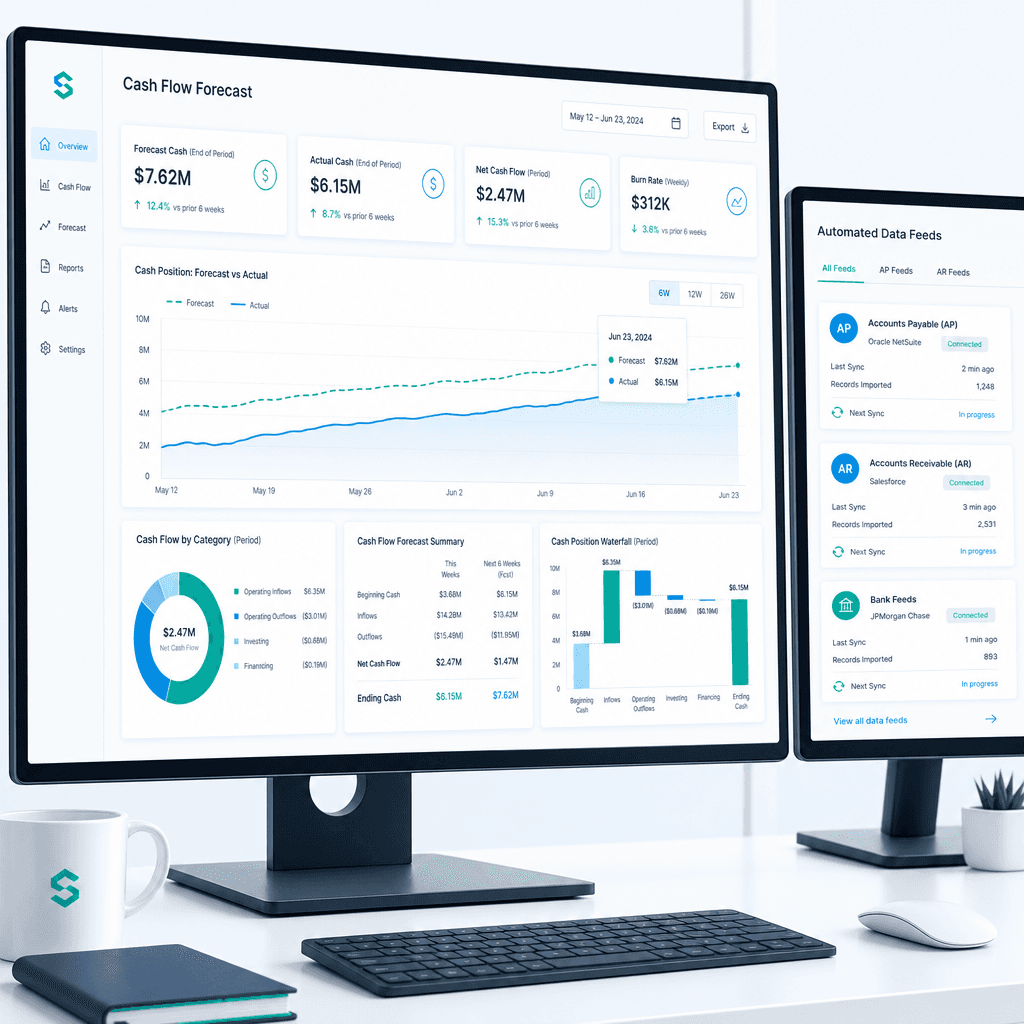
Cash Flow Forecasting Automation: A Practical Guide for Australian Finance Teams (2026)
If your finance team rebuilds the cash flow forecast from scratch every week or every month, you already know where the time goes. Someone pulls an AR ageing…
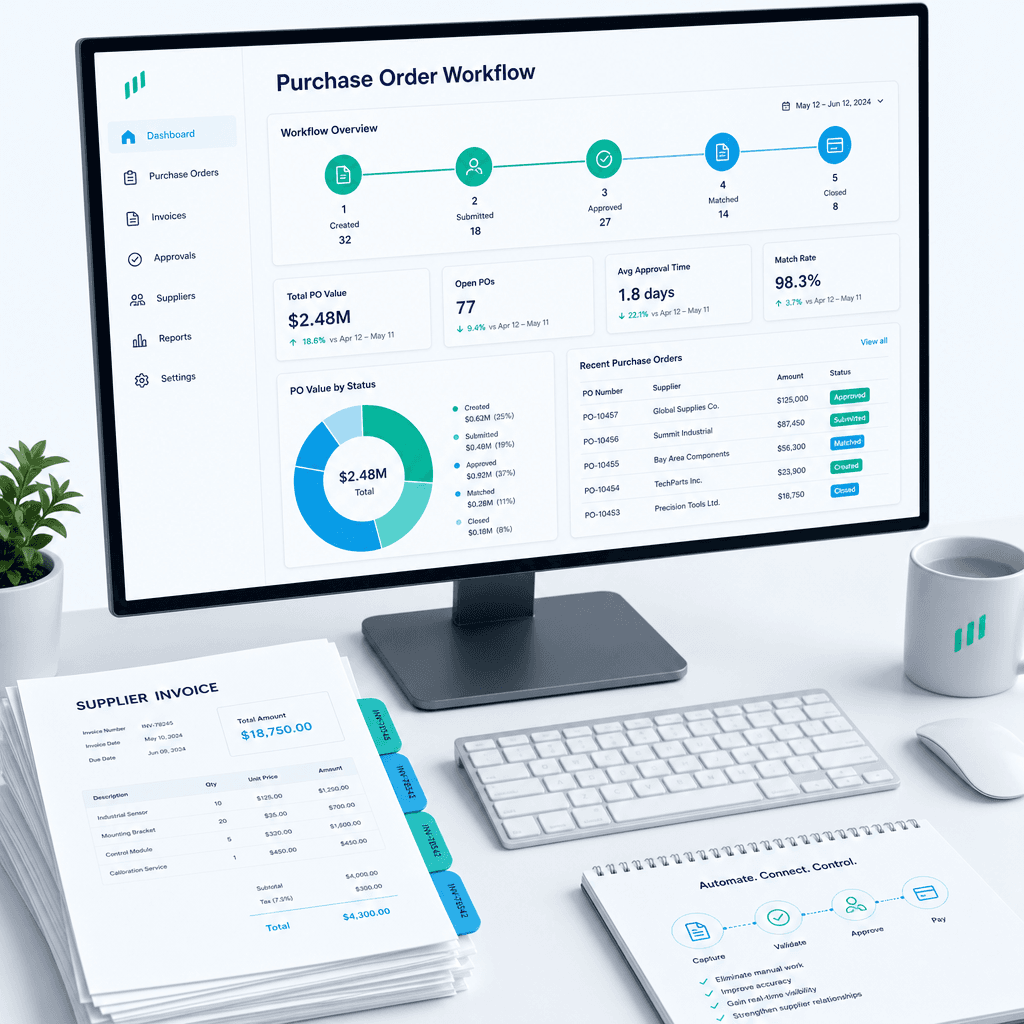
Purchase Order Automation: A Practical Guide for Australian Finance Teams (2026)
If your finance team is still raising purchase orders in a shared inbox, chasing approvals over email, and manually matching invoices line by line before month…