Ordron
For CFOs and finance leaders

Stop losing $104,000 a year to manual finance work.

Automate the AP, AR, reconciliations and reporting work draining your team. Built on 130 proven frameworks, tuned to your stack, delivered turnkey for Australian mid-market businesses.

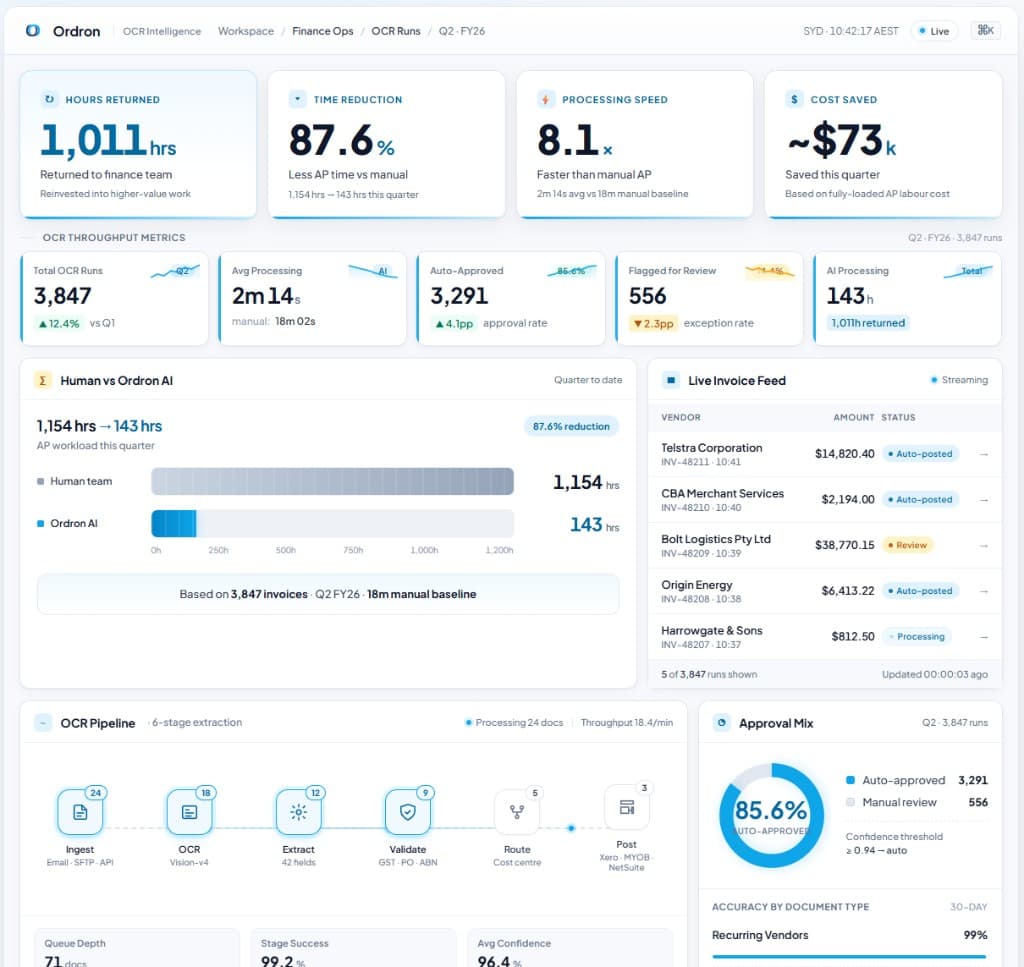
Ordron OCR Intelligence dashboard showing hours returned, time reduction and live invoice feed

Built for Australian finance teams running on

The cost of doing nothing

Every year a mid-market finance team loses around $104,000 to manual work.

The exact number for your team is probably higher or lower. Plug in four inputs below and see. We show the working so you can defend the answer to a CFO.

Cost of inaction calculator

Your team, your platform, your number.

Four inputs. Headline annual waste. Likely payback. Top three automations for your stack. Full written breakdown emailed on request.

5people
1FTEs in finance and accounting30
300per week
0Bills in plus AR invoices out1,500
10days
1From period end to signed-off reports20
Current platformChanges the named automations shown

All dollar figures in AUD. Assumes a blended finance rate of $55/hour and 50 working weeks per year.

Your annual cost of manual finance

$106,400

Ordron-style automation typically captures $79,500 of that per year. On a typical $10,000 project, payback lands at roughly 7 weeks.

Preview

Your full breakdown

Your team is losing $106,400 a year.

Every line of waste costed out, the three automations that recover the most hours, and a prioritised roadmap tailored to Xero. Delivered as a written PDF to your inbox.

One email. Unsubscribes in a click. You keep the report either way.

Who this is for

Does this sound like the job you are doing today?

Ordron is built for two audiences. Both spend more time on manual finance work than the business realises, and both are one decent automation project away from getting their week back.

CFO or finance director

You run finance at a growing mid-market business.

20 to 200 staff. $10M to $50M revenue. The team is good, but manual workflows are quietly draining time and creating risk that audit will eventually surface.

  • My team spends 20 hours a week on invoice matching alone.
  • Month-end close takes 10 days. It should take 2.
  • I know automation exists. I don't trust a chatbot with my ledger.

Usually triggered by

  • Staff turnover
  • Audit finding
  • Growth spurt
  • System upgrade
Owner or practice principal

You are the finance department at your own business.

5 to 50 staff. $1M to $15M revenue. You wear the CFO hat after hours because there is no budget to hire one, and the manual work keeps finding its way back to you.

  • I am going through 800 invoices a week just to find the errors.
  • I cannot afford an ops person but I need one yesterday.
  • I tried ChatGPT but it cannot actually touch my Xero data.

Usually triggered by

  • BAS season
  • Staff leaves
  • Client growth
  • Error incident
Four signals that finance needs automation

If more than one of these is true, the return on automating it is almost certainly bigger than the cost.

The Ordron Automation Diagnostic scores each of the four pillars below, so you know where the pain is concentrated before we ever get on a call.

Manual workload

Hours lost to repetitive, rules-based finance work.

  • 10 or more hours per week on data entry and reconciliations
  • Copy-paste between email, PDFs and the accounting system
  • Heavy spreadsheet reliance for core reporting

System disconnects

Multiple tools that do not speak to each other, forcing double-handling.

  • 5 or more platforms in the finance stack
  • Exports and re-imports between CRM, billing and ledger
  • Approvals happening in inboxes, not workflows

Errors, delays and risk

Rework, missed payments, audit exposure and key-person dependencies.

  • Month-end close running past 8 days
  • Weekly exceptions creating rework loops
  • Critical tasks only one team member understands

Scalability and operational maturity

Processes that only work because volume is still manageable and the team is still there.

  • Volume doubling would require new headcount
  • Reporting only runs because one person builds it
  • No documented workflow for AP, AR or close

Find your automation quick wins across all four pillars.

5-minute diagnostic. Instant results.

Find your automation quick wins
How Ordron builds

Finance automation that respects the controls finance actually needs.

The usual automation shop starts with a bot and hopes the rest works itself out. We start with the data, build the automations on top, and make the whole thing visible to you through a control panel. That is why the projects stay working after we hand them over.

  1. STAGE 01

    Database-first architecture

    Your data gets a proper home before any bot touches it.

    We stand up a centralised, isolated database on Azure so every automation writes against a controlled source of truth. No shared VMs. No scraping production.

    • Azure-hosted virtual machines
    • Client data isolation and encryption
    • Full audit trail on every transaction
  2. STAGE 02

    Automation layer

    Rules, APIs, OCR and Python stitched into the workflow you already run.

    We favour APIs where they exist, fall back to RPA where they do not, and wire in Python and OCR for the 20 percent that neither handle well. Exceptions always route to a human.

    • API and RPA hybrid model
    • OCR for document-heavy workflows
    • Human-in-the-loop by design
  3. STAGE 03

    Ordron Control Panel

    Real-time visibility for you, not a black box built on top of your data.

    Every automation streams its status into a custom dashboard so finance leaders can see what ran, what failed, what needs approval and what saved the team time this week.

    • Live automation status
    • Exceptions queued with owners
    • Time-saved and ROI reporting

Not enterprise RPA pricing. Not a point-solution bot. Custom finance infrastructure, delivered turnkey, priced for the mid-market.

Proof on the ground

Real Australian finance teams. Real numbers. Real automation that stayed working.

Names withheld until case studies are approved for publication.

Accounting practiceInvoice processing

From 20 hours a week of manual invoice review to under 2.

We built an OCR layer that reads 800+ supplier invoices a week, codes them against historical rules and routes exceptions to the right reviewer. The client now spends review time on the 10 percent that genuinely need a human.

90%time saved

- M.K., Partner, mid-tier accounting practice

Financial services firmFull stack build

Near-zero manual data entry across a HubSpot, Xero and timesheet stack.

HubSpot and Xero integration with a centralised database, automated timesheeting and a custom dashboard. The client now runs operations with near-zero manual data entry, and Ordron is embedded on a monthly partnership.

We stopped thinking about Ordron as a vendor six months in. They run our finance ops now.

Ongoingpartnership

- D.R., Head of Operations, boutique financial services firm

SME operationsSystems integration

CRM, accounting and project tools unified through an automation layer.

Connected a previously disconnected toolset so that project, billing and accounting data moves through a unified automation layer. Manual data entry across departments was eliminated as part of the engagement.

Zeromanual re-entry

- J.T., Managing Director, national SME operator

130+

Automation frameworks

13

Finance platforms supported

100%

Client retention on partnerships

THE 2026 BENCHMARK

The 2026 Australian Finance Team Benchmark Report

We're aggregating data from Australian mid-market finance operations across eight core metrics. Register now and we'll send you the full report the day it publishes.

One email. Delivered as a PDF. Unsubscribes in a click.

Expected publication: Q3 2026

Benchmark preview

Month-end close (days)

Peer range

Invoices per FTE / week

Peer range

Manual hours / week

Peer range

Automation coverage %

Peer range

Your teamPeer medianTop quartile
13 platforms, 130 automations

We work with the finance stack you already run, not the one a vendor wants to sell you.

Each platform has its own automation hub. Click through to see the named automations we have built there.

Not sure which automations apply to your stack?

The 5-minute diagnostic maps the top three for your platform and team size.

Running something else? If it has an API or a structured interface, we can usually automate against it. Read the full AU pillar guide: Finance automation in Australia.

See all platforms
The Ordron Automation Roadmap

A proper diagnostic, not a sales call with a certificate at the end.

60 minutes of focused workflow mapping plus a written report with prioritised opportunities and ROI projections. You keep the report whether you engage us or not. That is why it converts when people are ready, and builds trust when they are not.

  1. 01

    Book

    Answer a short form about your tech stack and team size. Pick a time that suits you.

  2. 02

    Discover

    We map your current workflows, identify pain points and assess automation readiness on a single video call.

  3. 03

    Deliver

    You receive a branded Automation Roadmap report with a prioritised roadmap and ROI projections on the top 3 opportunities.

  4. 04

    Decide

    Follow-up call to walk through findings. You take the report whether you engage Ordron or not.

Common questions

Straight answers to the objections we hear most often.

Is this just ChatGPT wrapped up in a service?

No. ChatGPT is a language model.

We already use what is built into Xero, MYOB or QuickBooks. Why do we need you?

Platform-native automation is great for the 60 percent of workflows that fit the platform's model.

Can we DIY this with UiPath or Power Automate?

Yes, if you have internal developer capacity and are prepared to own it forever. Most mid-market finance teams do not.

How is this different from ApprovalMax or Lightyear?

Point solutions like those solve one workflow extremely well.

How long until we actually see results?

Most quick-win projects deliver a working automation within 4 to 6 weeks from kickoff. Full infrastructure builds run 8 to 12 weeks depending on scope.

Will this disrupt our month-end close?

No. We build and test every automation in a staging environment that mirrors your live systems.

What about data security and audit trails?

Each client gets isolated, encrypted infrastructure on Azure. Every automated action is logged with inputs, outputs and the source system, so your auditors can trace exactly what ran, when, and why.

What does a project cost?

Most projects sit between $5,000 and $50,000 depending on scope, with partnerships from around $1,600 per month for ongoing work.

Start with the diagnostic. Finish with a finance team that gets its week back.

Five minutes now to see where your hours are going. Sixty minutes with Ordron to get a report that tells you what to do about it. Then it is up to you.