
Finance Automation for Healthcare & Aged Care in Australia: How Providers Are Streamlining AP, Payroll & Compliance Reporting
Ordron26 min read
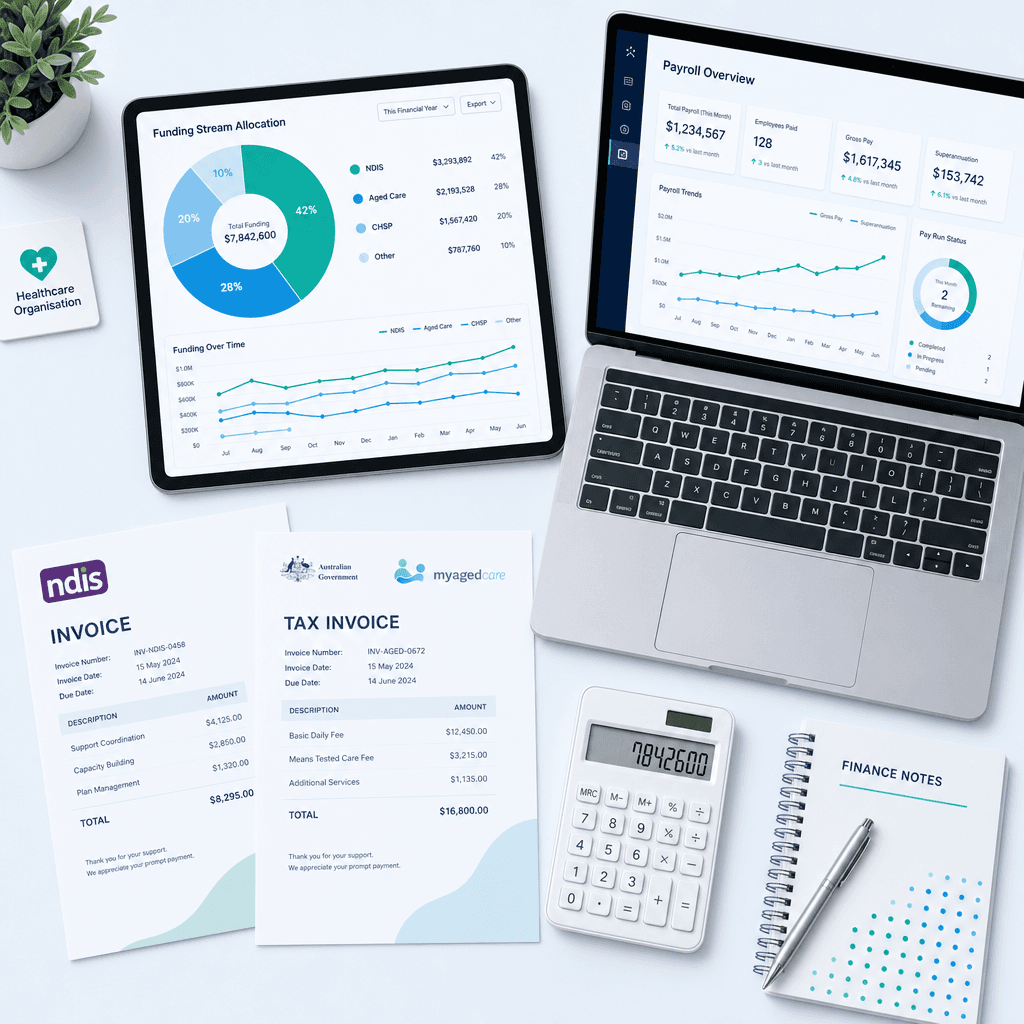
Australian healthcare and aged care providers are running some of the most complex finance operations in the country. On any given week, a mid-sized aged care provider might process hundreds of invoices split across AN-ACC, NDIS and private-pay funding streams, run payroll for a shift-based workforce covered by multiple modern awards, and prepare compliance reports for the Aged Care Quality and Safety Commission. Most of those tasks are still being done manually, in spreadsheets, by people who have better things to do.
That is not a technology problem. It is a prioritisation problem. The tools to automate these workflows exist today, they do not require replacing your existing systems, and the outcomes are measurable after go-live. The question is whether your finance team is spending its hours on work that requires human judgement, or on work that a well-scoped automation can handle in the background while your team does something more valuable.
This article covers the specific pain points that make healthcare and aged care finance uniquely difficult in Australia, the automation approaches that address each one, and the outcomes that providers are achieving in practice. There are no aspirational projections here. Only the numbers attached to work that has already been delivered.
Key Takeaways
- Healthcare and aged care AP is uniquely complex because invoices must be split and coded across multiple funding sources (NDIS, Medicare, AN-ACC) at the line-item level, not just at the header level.
- Shift-based payroll under multiple modern awards, combined with ATO STP Phase 2 obligations, creates a compliance burden that manual processes struggle to keep clean.
- AN-ACC and NDIS compliance reporting requires granular, auditable data that most manual finance workflows cannot produce quickly or accurately.
- Automation does not require replacing your ERP, your payroll platform, or your accounting software. The best results are often achieved by automating the manual steps between existing systems.
- ROI timelines for healthcare finance automation are typically 3-6 months when the automation is scoped around the specific bottlenecks draining the most team hours each week.
- Providers who automate reconciliation across funding streams gain real-time visibility into cash position that monthly manual reporting cannot deliver.
Manual vs Automated: Healthcare Finance Workflows at a Glance
| Workflow | Manual Approach | Automated Approach | Typical Time Saving |
|---|---|---|---|
| Accounts payable | Staff read, code and enter invoices line by line | OCR + intelligent coding rules auto-process invoices, route exceptions to humans | 65-80% reduction in processing time |
| Multi-funder invoice splitting | Manual allocation to NDIS, AN-ACC, Medicare cost centres | Rules-based engine splits and codes at line-item level automatically | Near-elimination of manual allocation |
| Payroll award interpretation | Manual timesheet review against award tables | Automated award interpretation engine applies correct rates by shift type | Significant reduction in payroll errors and correction cycles |
| STP Phase 2 reporting | Manual payroll data preparation and submission | Automated STP-compliant payroll data extraction and lodgement | Hours per pay period returned to payroll team |
| AN-ACC compliance reporting | Monthly manual data collation from multiple sources | Automated data aggregation and report generation on schedule | Reporting time cut from days to hours |
| NDIS plan reconciliation | Manual matching of service delivery records to plan budgets | Automated reconciliation engine matches records and flags variances | 80%+ reduction in reconciliation time |
| Bank reconciliation | Daily manual matching in accounting platform | Automated GL tagging and bank feed matching | 80% reduction in AR reconciliation time |
Why Healthcare Finance Is Uniquely Complex
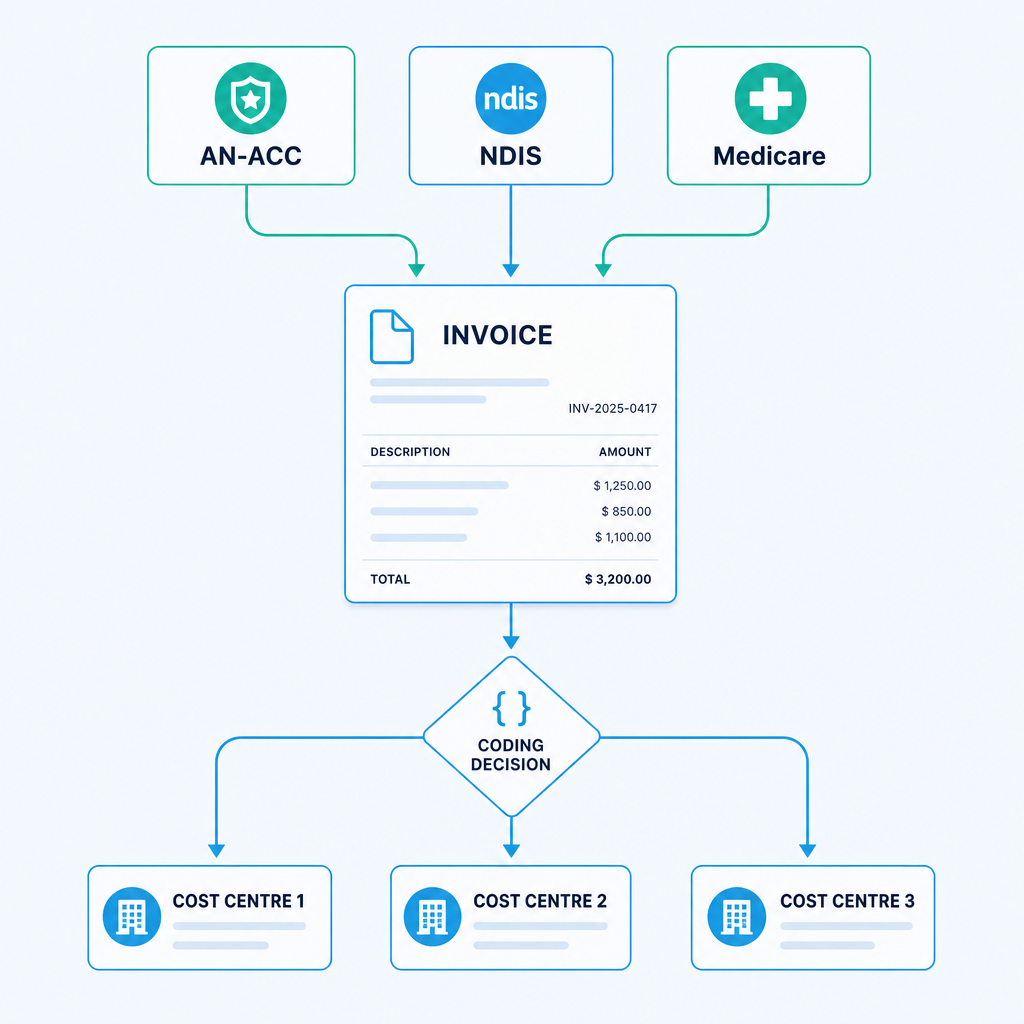
Every industry has finance complexity. Healthcare and aged care in Australia has a particular combination of factors that makes manual finance operations genuinely unsustainable at scale.
Multiple Funding Streams, One Invoice
A residential aged care facility might receive a single invoice from a physiotherapy supplier that needs to be split across AN-ACC basic care funding, a resident's NDIS plan, and private-pay billing, all for services delivered on the same day. Coding that invoice correctly requires the finance officer to know the funding rules for each stream, the resident's current plan status, and the applicable cost centre structure. Multiply that across hundreds of invoices per month and you have a process that is slow, error-prone, and almost impossible to audit cleanly.
The Australian National Aged Care Classification (AN-ACC) funding model, introduced in October 2022, replaced the old ACFI system with a casemix-based approach that ties funding directly to resident classification. That classification can change. When it does, the cost centre coding for every subsequent invoice needs to reflect the new classification. In a manual workflow, that update depends on a finance officer being told about the change and remembering to update their coding rules. In an automated workflow, the classification update flows through the system and all subsequent processing reflects it automatically.
Award Complexity for Shift-Based Workforces
Healthcare and aged care workforces are among the most award-complex in Australia. The Aged Care Award 2010 and the Health Professionals and Support Services Award 2020 between them cover dozens of classification levels, with penalty rates for evenings, weekends, public holidays, and overtime that vary by classification and shift start time. Add in enterprise agreements that sit on top of awards, and the permutations a payroll team needs to calculate correctly for every pay period are significant.
The Fair Work Commission's decision in the aged care sector work value case, which delivered substantial pay increases staged across 2023 and 2024, added further complexity. Award rates changed, classification structures were updated, and providers needed to ensure their payroll systems reflected those changes accurately from the effective dates. Providers running manual award interpretation processes had to manually update rate tables and verify the changes had flowed through correctly. That is not a one-time task, award rates are reviewed regularly and payroll teams need a process that keeps pace.
STP Phase 2 and Payroll Compliance
The ATO's Single Touch Payroll Phase 2 expansion requires employers to report disaggregated payroll data with each pay event, including income type, tax treatment code, and detailed allowance breakdowns. For healthcare providers with complex award-based payroll, the number of discrete data fields that need to be reported correctly for each employee each pay period is substantial. Errors in STP reporting create ATO compliance risk and, in some cases, trigger payroll audits.
You can read more about the specific automation approaches for STP Phase 2 compliance in our detailed guide on finance automation and Single Touch Payroll.
Compliance Reporting That Never Stops
The Aged Care Quality and Safety Commission requires providers to maintain detailed records that can be produced on request during audits. NDIS providers are subject to the NDIS Quality and Safeguards Commission's audit requirements. Both regulatory frameworks require that financial records are accurate, complete, and traceable to source documents. A manual finance process, by definition, has gaps. Data re-keyed from one system to another loses its audit trail at the point of re-entry.
AP Automation for Multi-Funder Invoicing (NDIS, Medicare, AN-ACC)
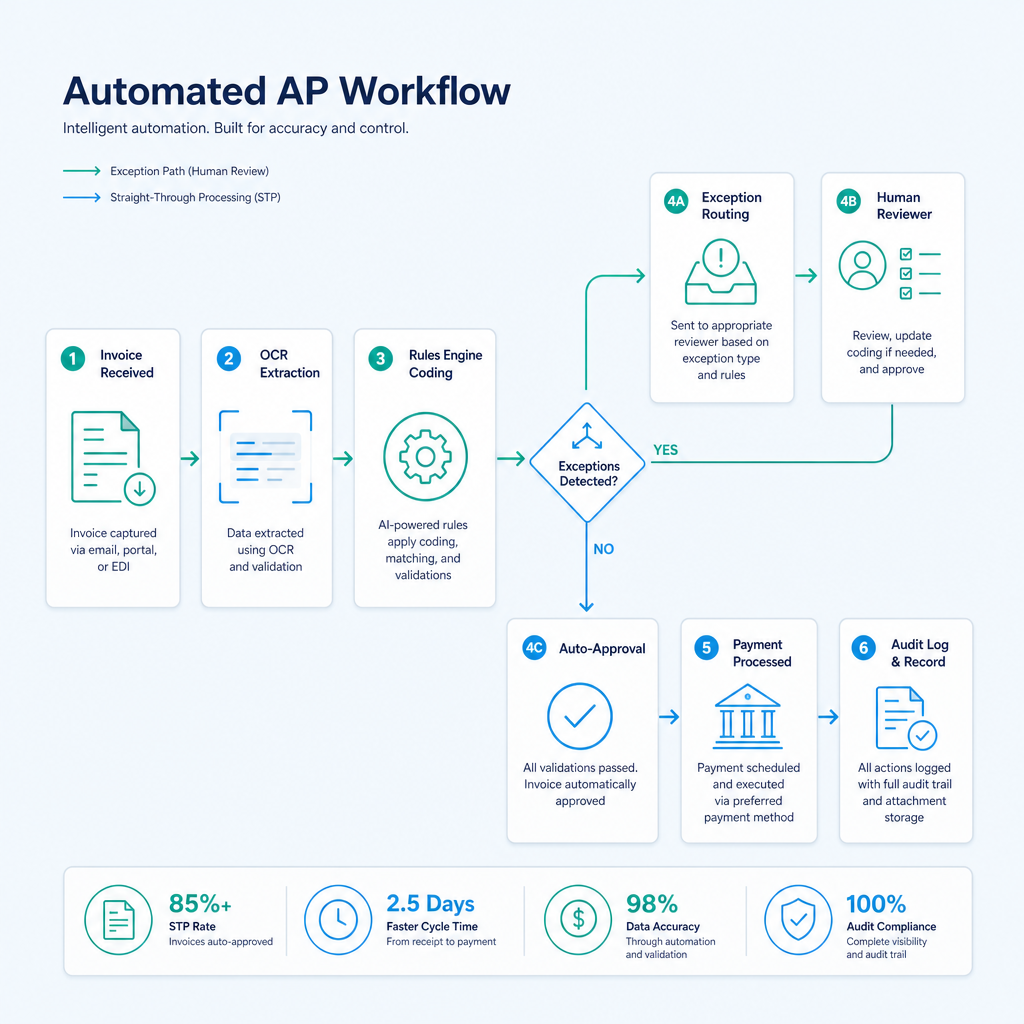
Accounts payable automation in healthcare is not just about processing invoices faster. It is about processing them correctly, which in a multi-funder environment means splitting them accurately across funding streams at the line-item level, coding them to the right cost centres, and maintaining an audit trail that a compliance auditor can follow from the invoice back to the funding source.
How Intelligent AP Automation Works in a Multi-Funder Environment
A well-scoped AP automation for a healthcare or aged care provider typically combines three capabilities. First, OCR or intelligent document understanding reads the incoming invoice and extracts the relevant fields: supplier, date, line items, amounts, and any reference numbers that tie the invoice to a purchase order or service agreement. Second, a rules engine applies the coding logic that would otherwise require a finance officer to make a judgement call. That rules engine knows which supplier invoices are NDIS-reimbursable, which are AN-ACC-funded, and how to handle invoices that span multiple funding streams. Third, the system routes only the exceptions, invoices that fall outside the rules or exceed variance thresholds, to a human reviewer. Everything else is processed automatically.
In distribution and logistics environments, we have consistently achieved greater than 95 per cent coding accuracy with this approach, and more than 80 per cent of complex multi-split invoices fully auto-processed without human intervention. The healthcare environment has additional complexity because the coding rules are tied to resident or participant status, which changes over time. But the underlying approach is the same: embed the logic in the system, route only exceptions to humans, and measure the outcome after go-live.
For a detailed breakdown of how AP automation is structured, our accounts payable automation guide covers the technical architecture and implementation sequence.
What This Looks Like in Practice
When I worked with a national logistics provider running its AP process inside SharePoint across multiple depots, each invoice batch was taking approximately four hours to process. Staff were manually filing documents and keying data from supplier invoices into the system. We plugged OCR and workflow logic directly into the existing SharePoint-based AP process, with no new software introduced. One hundred per cent of filing was automated and coding rules were embedded into the workflow. The AP cycle time dropped from four hours to fifteen minutes per batch.
That was a logistics environment, not healthcare, but the structural problem is identical: high invoice volumes, multiple cost centres, manual coding, and a team spending most of its time on work that does not require human judgement. Healthcare adds the layer of funding source complexity, which increases the value of getting the automation right because an incorrectly coded invoice in an NDIS or AN-ACC context is not just an accounting error, it is a compliance issue.
NDIS Invoicing Specifics
NDIS invoicing automation needs to account for the NDIS Pricing Arrangements and Price Limits, which the National Disability Insurance Agency updates regularly. Invoice amounts need to be validated against the applicable support item rate for the registration group and state. Support item codes need to match the service delivery records. And the total claimed against a participant's plan needs to stay within the approved plan budget.
Automating these checks does not require replacing your NDIS management software. In most cases, it means building a validation layer that sits between your service delivery records and your AP or billing system, checks each invoice against the current pricing arrangements, and flags variances before they become claims errors.
Payroll Automation for Shift-Based Healthcare Workforces
Healthcare payroll is where most finance teams feel the most pain most regularly, because it happens every fortnight regardless of whether the team has capacity for it. A shift-based workforce means timesheets, and timesheets in a healthcare environment mean award interpretation at scale.
Award Interpretation Automation
Modern payroll platforms like Employment Hero, KeyPay and Chris21 have built-in award interpretation engines for common awards. The question for most healthcare providers is not whether their platform supports the Aged Care Award, it almost certainly does, but whether the configuration is correct, whether enterprise agreement variations have been applied accurately, and whether the system is being kept up to date as award rates change.
Automation in this context often means building a validation layer that checks payroll outputs against the expected award rates before the pay run is approved, rather than relying on a payroll officer to manually verify that every employee's pay is correct. That validation layer can flag anomalies, an employee paid at a rate that does not match their classification, a penalty rate applied to a shift that does not qualify, and route them to the payroll manager for review before the pay run goes through.
STP Phase 2 Compliance Automation
STP Phase 2 requires that every pay event lodgement includes disaggregated income type data. For healthcare providers with complex allowance structures, uniform allowances, meal allowances, on-call allowances, each allowance type needs to be mapped to the correct ATO reporting category and reported separately.
The automation task here is ensuring that the payroll system's allowance configuration matches the ATO's STP Phase 2 reporting requirements, and that the data extracted for each pay event lodgement is complete and correctly structured. Errors in STP reporting do not typically result in immediate ATO action, but they create a compliance liability that grows with each incorrect lodgement. Getting the configuration right once, and automating the validation on each pay run, is significantly less costly than correcting months of incorrect STP data after an ATO review.
Compliance and Audit Trail Automation for Aged Care Reporting
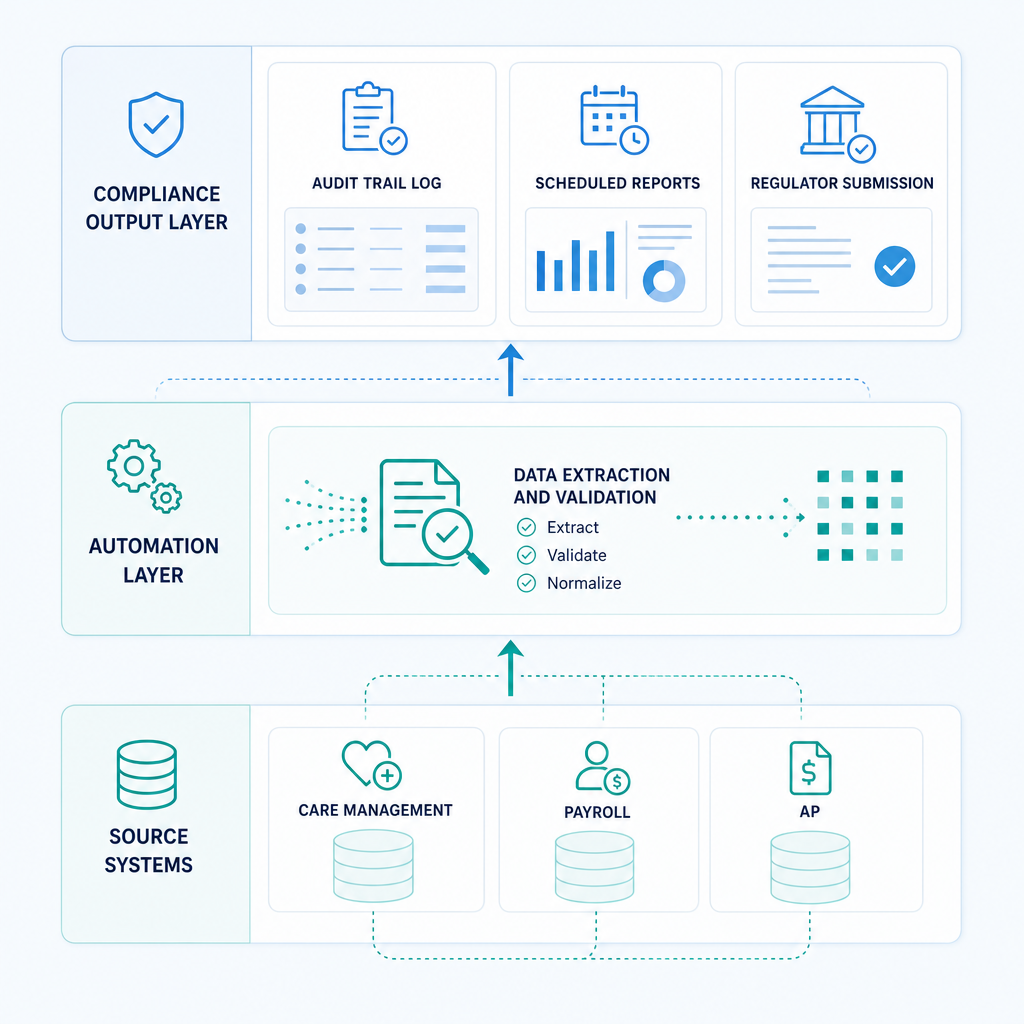
The Aged Care Quality and Safety Commission's audit process requires that providers can produce accurate financial records on request. AN-ACC funding calculations need to be supported by resident classification records. NDIS plan expenditure needs to be traceable to individual service delivery events. And any discrepancy between what was claimed and what was delivered needs to be explainable.
Building an Automated Audit Trail
An automated audit trail is not a separate system bolted onto your existing finance process. It is a property of the automation itself. When an invoice is processed by an automated AP system, every step, receipt, OCR extraction, coding, approval, payment, is logged with a timestamp and a user or system identifier. That log is the audit trail. It exists because the automation created it, not because a finance officer remembered to document what they did.
For aged care providers, this means that when a compliance auditor asks for evidence that a specific AN-ACC-funded service was correctly invoiced and paid, the answer is a report generated from the automation log, not a manual search through filing systems and email chains.
We have a detailed breakdown of how to structure automation for compliance and audit trail requirements in our compliance and audit trail automation guide.
Automated Compliance Reporting Schedules
Beyond audit readiness, compliance reporting in aged care involves regular scheduled submissions. Star ratings data, financial reports to the Department of Health and Aged Care, and quality indicator data all require that financial and operational records are collated, validated, and submitted on schedule.
Automating these reporting schedules means defining the data required for each report, building the extraction and aggregation logic once, and scheduling the report generation to run automatically ahead of each submission deadline. The finance team reviews the output rather than building it from scratch each time. That shift from production to review is where significant team hours are returned.
Reconciliation Across Multiple Funding Streams
Reconciliation in a multi-funder healthcare environment is structurally more complex than reconciliation in most other industries, because the income side of the ledger has multiple sources (AN-ACC payments from the Commonwealth, NDIS claims processed through the NDIS portal, private-pay resident fees, Medicare bulk billing) each with its own payment timing, remittance format, and reconciliation logic.
Automating Multi-Funder Reconciliation
The reconciliation task for each funding stream is distinct. AN-ACC payments arrive as scheduled Commonwealth payments that need to be matched to the expected amount based on the resident classification mix for the period. NDIS claims are paid after submission to the NDIA portal, with a processing lag that means the cash receipt and the service delivery event are separated by days or weeks. Private-pay fees need to be matched to resident invoices and aged for collections purposes.
Automating this reconciliation means building stream-specific matching logic for each funding source and a consolidated view that shows the finance manager the reconciliation status across all streams in one place. The underlying approach is the same one we have applied in logistics and distribution environments, where we achieved an 80 per cent reduction in AR reconciliation time for a freight operator managing hundreds of recurring clients inside Xero.
For more on how reconciliation automation is structured technically, our reconciliation automation guide covers the approach in detail.
Real-Time Cash Visibility
One of the most practical outcomes of automated reconciliation in healthcare is real-time cash position visibility. When funding stream reconciliation runs nightly rather than monthly, the finance manager knows today what the cash position is across all funding sources. That visibility changes the quality of financial decisions, whether to defer a capital purchase, whether to draw on a facility line, whether to accelerate a collection effort, because those decisions are based on current data rather than last month's reconciliation.
How to Evaluate an Automation Partner for Healthcare
Not every automation provider understands healthcare finance. The questions worth asking before engaging anyone are specific.
What They Know About Healthcare-Specific Complexity
Ask the provider to describe how they handle multi-funder invoice splitting. If they describe a generic AP automation that codes invoices to cost centres, they have not thought about the problem in healthcare terms. The answer you want includes a description of how the coding rules are configured for NDIS versus AN-ACC versus private-pay, how changes in resident classification are propagated through the coding logic, and how the system handles invoices that span multiple funding sources.
Whether They Work With Your Existing Systems
A common mistake in healthcare finance automation is assuming that the current systems need to be replaced before automation is possible. That assumption is almost always wrong. An aged care provider running TechOne, Civica or AlayaCare alongside Xero or MYOB does not need to replace any of those systems to automate its AP, payroll validation, or reconciliation workflows. The automation sits between the systems and handles the steps that are currently being done manually. The systems themselves keep doing what they do.
This is a non-consensus view in this industry. Most providers are told by system vendors that the answer to their finance complexity is a new, integrated platform. Our experience across dozens of engagements is that the bottleneck is almost never the platform. It is the specific manual steps performed inside or between platforms. Automating those steps with RPA, OCR and workflow logic produces real outcomes faster and at lower risk than a system replacement project.
Whether Their Results Are Measured After Go-Live
Ask for case studies. Then ask whether the numbers in those case studies are projections or measured results. Aspirational projections are easy to produce and rarely accountable. The number that matters to a finance director is what changed after the automation went live, not what the sales deck said would change before it started.
At Ordron, we publish only measured results. If a case study cannot be supported by a post-go-live measurement, it does not go on the page. You can review the outcomes we have published on our case studies page.
Starting With a Scorecard
If you are not sure where to start, the most useful first step is a structured assessment of where your finance team is spending its manual hours. A scorecard approach maps the specific tasks, the time cost of each, and the automation potential, so the highest-value quick wins are visible before any commitment is made. You can complete Ordron's finance automation scorecard to get a structured view of where your team's hours are going.
Real-World Outcomes: What Healthcare Providers Are Achieving
The outcomes from finance automation in healthcare are consistent with what we see across other complex, multi-entity finance environments. The specific numbers vary by the size of the operation and the severity of the manual process being replaced, but the patterns are clear.
AP Processing Time
Healthcare providers who automate their AP workflow with intelligent document understanding and coding rules consistently reduce invoice processing time by 60-80 per cent. For a team processing 500 invoices per month, that is the difference between a full-time finance officer spending most of their week on AP and the same officer spending a few hours reviewing exceptions.
Payroll Error Rates
Automated award interpretation and payroll validation catch the errors that manual review misses. A finance team reviewing 200 timesheets against multiple award classifications in the week before payroll is closed is going to miss some. An automated validation layer that runs every pay period against the current award rates, and routes anomalies to the payroll manager before the pay run is approved, catches them before they become overpayments or underpayments. Underpayment in the healthcare sector carries serious regulatory and reputational risk, the Fair Work Ombudsman has pursued healthcare employers for award non-compliance, and the ATO's STP data creates a paper trail that makes underpayment history visible.
Compliance Audit Readiness
Providers who have automated their compliance data collection report a significant reduction in the time and cost of preparing for scheduled audits and responding to unscheduled audit requests. When the audit trail is a byproduct of the automation rather than a manual documentation task, it exists, it is complete, and it is available immediately.
Hours Returned
Across the work we have delivered in complex multi-entity finance environments, the maximum manual work reduction achieved is 85 per cent, measured across engagements spanning eight industries. For a healthcare finance team currently spending 40 hours per month on manual AP, payroll reconciliation, and compliance data collation, an 85 per cent reduction means 34 hours returned to work that requires human judgement. That is nearly a full working week per month redirected from processing to analysis, from data entry to decision support.
If you want to understand what your specific numbers look like, our finance automation overview is the starting point, and our contact page is where you can start a conversation about your specific environment.
References
-
Australian Taxation Office, Single Touch Payroll Phase 2 Employer Guidance: The ATO's official guidance on STP Phase 2 reporting requirements, including income type disaggregation, allowance reporting categories, and transition timelines for employers. Available through the ATO's website under the Single Touch Payroll section.
-
NDIS Pricing Arrangements and Price Limits (National Disability Insurance Agency): The NDIA's regularly updated schedule of support item codes, registration group categories, and price limits by state and territory. The primary reference for validating NDIS invoice amounts against approved rates.
-
Australian National Aged Care Classification (AN-ACC) Funding Model Documentation (Department of Health and Aged Care): The Department's technical documentation covering the AN-ACC casemix funding model, resident classification process, and funding calculation methodology introduced in October 2022.
-
Fair Work Commission, Aged Care Industry Sector Work Value Case and Modern Award Rate Schedules: The Fair Work Commission's determinations from the aged care work value case, including staged pay rate increases, updated classification structures under the Aged Care Award 2010 and Health Professionals and Support Services Award 2020.
-
HESTA Aged Care Workforce Report: HESTA's research on workforce composition, employment conditions, and financial sustainability in the Australian aged care sector, providing context for the scale and complexity of healthcare payroll obligations in Australia.
-
Office of the Australian Information Commissioner, Australian Privacy Principles Guidelines (APP 11): The OAIC's guidance on security obligations for organisations holding sensitive information, including health records, under the Privacy Act 1988. Relevant to data security requirements for any automation accessing clinical or payroll data.
Frequently asked questions
- Can NDIS invoicing be fully automated, and what are the limitations?
- NDIS invoicing can be automated to a high degree, but full automation requires that your service delivery records are structured and complete before the automation touches them. The automation validates invoice amounts against the current NDIS Pricing Arrangements and Price Limits, matches invoices to support item codes, and checks claimed amounts against plan budgets. Exceptions are routed to a human reviewer. The limitation is that the automation is only as good as the service delivery data feeding it.
- Which modern awards apply to aged care payroll, and how does automation handle them?
- The two primary awards for aged care in Australia are the Aged Care Award 2010 and the Health Professionals and Support Services Award 2020. Many providers also have enterprise agreements that sit on top of these awards. Payroll automation for aged care needs to be configured for the specific award and enterprise agreement that applies to each employee group. The most valuable automation layer is a validation check that runs each pay period and routes anomalies to the payroll manager before the pay run is approved.
- What does AN-ACC compliance reporting require from a finance systems perspective?
- AN-ACC funding is calculated based on each resident's classification. The finance system needs to record each resident's current classification, the effective date of that classification, and the resulting funding entitlement. Compliance reporting requires that providers can demonstrate the relationship between classifications, funding amounts received, and care costs incurred. Automating this means connecting the care management system to the finance system so that data is consistent and auditable without manual re-entry.
- What is a realistic ROI timeline for finance automation in a healthcare organisation?
- For most healthcare providers with clear manual bottlenecks, the ROI timeline is 3-6 months after go-live. Projects scoped around removing specific manual steps deliver faster returns than projects scoped around replacing infrastructure. Starting with a scorecard assessment of where the manual hours are going is the most reliable way to identify the right starting point and scope the first automation correctly.
- Are Xero and MYOB suitable platforms for healthcare finance automation?
- Xero and MYOB are suitable accounting platforms for many healthcare and aged care providers. The question is not whether the platform is right, but whether the processes running between your clinical management system, payroll platform, and accounting software are being handled efficiently. Most manual work in healthcare finance happens in the gaps between systems. Automating those gaps does not require changing your accounting platform.
- How is financial data protected when automation tools access payroll and clinical records?
- Data security for healthcare finance automation is governed by the Privacy Act 1988 and the Australian Privacy Principles, with specific obligations for health information under APP 11. Automation tools that access payroll or clinical records must not store sensitive data beyond what is required for the task, access must be role-restricted and logged, and data in transit must be encrypted. Reputable automation providers will document their security architecture before engagement.
- Can healthcare finance automation work without replacing existing software like TechOne, Civica, or AlayaCare?
- Yes. RPA and OCR-based automation works by interacting with existing systems at the interface level, which means it does not require API access or system replacement. Automation around twenty-year-old ERPs with no APIs has delivered measurable outcomes from day one after go-live without modifying the underlying system. The same approach applies to TechOne, Civica, AlayaCare, and any other platform your organisation runs.
- How do we get started with finance automation as a healthcare provider?
- The most useful first step is a structured assessment of where your finance team's manual hours are going. A finance automation scorecard produces that baseline quickly. From there, the scoping conversation focuses on the highest-value bottleneck, the exact automation to address it, and the measurement approach for the post-go-live outcome. Starting with a single, well-defined process and measuring the result before expanding scope is the approach that consistently delivers the fastest return.
Ordron
Finance automation team, Sydney
Ordron builds the finance automation infrastructure that runs AP, AR, reconciliations and reporting on autopilot for Australian mid-market businesses.
More from the Ordron Insights catalogue
Selected by topic. Updated as the agent publishes.
Cash Flow Forecasting Automation: A Practical Guide for Australian Finance Teams (2026)
If your finance team rebuilds the cash flow forecast from scratch every week or every month, you already know where the time goes. Someone pulls an AR ageing…
Purchase Order Automation: A Practical Guide for Australian Finance Teams (2026)
If your finance team is still raising purchase orders in a shared inbox, chasing approvals over email, and manually matching invoices line by line before month…
Payroll Automation in Australia: A Practical STP & Single Touch Payroll Guide for Finance Teams (2026)
Payroll in Australia is not complicated because the maths is hard. It is complicated because the obligations are layered, the data sits in multiple systems,…