
E-Invoicing in Australia: What the Peppol Mandate Means for Finance Teams (And How to Prepare)
Ordron24 min read
The Australian Government has been clear: PDF invoices sent by email are not e-invoices. They never were. What the government is rolling out, and accelerating, is a structured data standard called Peppol, and the gap between where most Australian finance teams sit today and where compliance requires them to be is wider than most realise.
In 2026, mandatory Peppol e-invoicing is no longer a distant policy discussion. The phased rollout has moved through Commonwealth agencies, into larger government suppliers, and the trajectory toward broader business coverage is well established. Finance teams that have been watching and waiting are running out of runway. Those that confuse digitising their existing PDF workflow with genuine e-invoicing compliance are exposed.
This article explains what Peppol e-invoicing actually is in plain terms, who is affected and when, how it changes accounts payable and receivable workflows, and the concrete steps finance teams should be taking right now. If your business invoices a government agency or trades with large enterprise buyers, this is not a back-burner item.
Key Takeaways
- Peppol e-invoicing transmits structured data directly between business systems. It is not a PDF, an email attachment, or a scanned document.
- The Australian Government mandate began with Commonwealth agencies and is progressively expanding to cover government suppliers and, by trajectory, broader business-to-business transactions.
- Software platforms including Xero, MYOB, and major ERPs are building Peppol-accredited access points, but platform readiness varies and configuration is not automatic.
- Automating e-invoicing compliance does not require replacing your existing ERP or accounting software. The work sits in bridging the gap between what your systems already do and what Peppol requires.
- Early adoption delivers real cost and cycle-time advantages. Non-compliance with government supplier requirements risks exclusion from procurement processes, not just regulatory penalties.
- Finance teams should assess their current invoice volumes, software versions, and AP and AR workflows against Peppol requirements before assuming their existing setup is sufficient.
Summary Table: Peppol E-Invoicing Mandate Phases in Australia
| Phase | Who Is Affected | Requirement | Status (2026) |
|---|---|---|---|
| Phase 1 | All Commonwealth agencies | Must be capable of receiving Peppol e-invoices | Complete |
| Phase 2 | Commonwealth agencies as senders | Must send Peppol e-invoices to enabled suppliers | Largely complete |
| Phase 3 | Large government suppliers (by contract) | Must send and receive via Peppol | Active and expanding |
| Phase 4 | Broader government supplier base | Peppol capability expected as procurement condition | In progress, 2026 |
| B2B trajectory | Large enterprise and mid-market | Voluntary but increasingly expected by large buyers | Growing adoption |
| SME threshold | Small businesses under $10M turnover | Not yet mandated, but platform readiness advisable | Preparation phase |
What Is Peppol E-Invoicing? (Plain English)
Peppol stands for Pan-European Public Procurement On-Line. The name is a legacy of its European origins, but the framework is now a global standard, and Australia is one of its most active adopters outside Europe.
The core idea is straightforward. Instead of a supplier creating an invoice in their accounting software, exporting it as a PDF, emailing it to a buyer, and having the buyer's AP team manually re-key the data into their own system, Peppol transmits the invoice as a structured data file directly from the supplier's system to the buyer's system. No email. No PDF. No manual re-entry.
The technical mechanism involves four components. Suppliers and buyers each connect to an accredited Peppol Access Point. These access points communicate through the Peppol network using a standardised message format. In Australia, the relevant specification is the A-NZ Peppol BIS Billing 3.0 standard, which defines exactly what data fields an invoice must contain and how they must be formatted.
The result is that the invoice arrives inside the buyer's ERP or accounting software as clean, validated, machine-readable data. The buyer does not need to scan it, re-key it, or interpret a PDF layout. The data is already structured, coded, and ready for three-way matching against purchase orders and receipts.
What Peppol is not: it is not a government portal you log into to submit invoices. It is not a PDF you email to a special address. It is not an EDI system specific to one industry or one buyer. It is an open network that any accredited access point can connect to, meaning a supplier with a Peppol-enabled accounting platform can transact with any Peppol-enabled buyer, regardless of what software the buyer runs.
The Australian Business Number (ABN) serves as the identifier on the Peppol network in Australia, which means businesses do not need a separate Peppol registration number. Your ABN is your Peppol address, provided your software or service provider has registered it with an accredited access point.
The Australian Government Mandate Timeline and Who It Affects
The Australian Taxation Office (ATO) and the Department of Industry, Science and Resources (DISR) have been the primary drivers of Peppol adoption in Australia, working within a framework set by the Digital Business Council.
The mandate began with a clear starting point: all Commonwealth agencies were required to be capable of receiving Peppol e-invoices. That baseline is now established. The expansion has moved in two directions simultaneously: requiring agencies to send as well as receive, and requiring their suppliers to be capable of sending.
For finance teams at businesses that supply goods or services to Commonwealth agencies, the practical implication is that Peppol capability is increasingly a condition of doing business, not a value-add feature. Procurement processes at the federal level are being structured around the assumption that suppliers can transact electronically in the Peppol format.
Beyond government procurement, large private sector buyers are beginning to follow the same trajectory. Enterprise buyers with sophisticated AP automation are starting to prefer or require Peppol-format invoices from their supplier bases, because it removes the OCR capture step on their end and improves their own processing accuracy. This is the same pattern that unfolded in Europe after mandatory adoption in public procurement: government mandates drive infrastructure build, and enterprise buyers then leverage that infrastructure.
For smaller Australian businesses, the question is not whether Peppol is relevant but when. Businesses under $10 million in annual turnover are not currently mandated, but if your largest customer is a Commonwealth agency or a large enterprise buyer who adopts Peppol requirements, the threshold that matters is theirs, not the government's general SME threshold.
The ATO has published guidance that businesses should contact their software provider to understand their Peppol readiness. That guidance understates the urgency for businesses in the government supply chain.
How E-Invoicing Differs from Emailing PDFs
This is the most important conceptual shift for finance teams to make, and it is also the one most commonly misunderstood.
Emailing a PDF invoice is a document delivery process. A human created the document, a human receives it, and unless OCR or manual keying intervenes, a human re-enters the data into the buyer's system. The data quality at the point of receipt depends entirely on the quality of the OCR engine or the accuracy of the person doing the keying.
Peppol e-invoicing is a data transmission process. The invoice is not a document. It is a data payload. The supplier's system sends a structured XML file through its access point. The buyer's system receives that file through its access point and parses the data directly into its own database. There is no document to read, no layout to interpret, no data to re-key.
The practical consequences for finance teams are significant.
On the accounts payable side, Peppol invoices arrive with validated data already structured for system ingestion. Tax amounts, line items, payment terms, supplier ABN, and invoice reference numbers are all in defined fields. Three-way PO matching becomes faster and more reliable because the invoice data is already clean. Exceptions, where the data does not match the PO, are routed for human review. Everything else processes automatically.
On the accounts receivable side, Peppol means your invoice reaches your customer's system faster, with fewer errors, and with no risk of the email going to spam or the PDF being unreadable. Payment cycles that are delayed by invoice receipt and processing delays compress. In sectors where payment terms of 30 days are standard, a two-day reduction in the time it takes a buyer to process a received invoice has real cash flow value at scale.
The difference matters because finance teams that upgrade their PDF workflow, perhaps adding OCR capture or a portal submission step, are not implementing Peppol e-invoicing. They are digitising a manual process. Peppol eliminates the document layer entirely.
For a detailed breakdown of how this applies to your accounts payable workflow specifically, see our accounts payable automation guide.
Impact on AP and AR Workflows
The impact of Peppol on accounts payable teams is direct and, for businesses that have invested in AP automation, largely positive. For businesses still running manual AP processes, the transition creates an opportunity that should be taken seriously.
In a Peppol-enabled AP workflow, invoices from enabled suppliers arrive as structured data. An intelligent matching layer compares each invoice against the relevant purchase order and goods receipt. Where all three match within defined tolerances, the invoice is approved and queued for payment without human intervention. Only genuine exceptions, a quantity discrepancy, a price variance, a missing PO reference, reach a human reviewer.
I have seen this pattern play out at scale. Running OCR capture and workflow logic into an existing accounts payable environment, without purchasing new software, we reduced AP cycle time from four hours per batch to 15 minutes. The same logic applies to Peppol: when the data arrives clean, the matching process becomes a rules engine, not a manual task.
For AR teams, Peppol changes the way invoices are dispatched. Instead of printing or generating a PDF, the AR system sends the structured invoice data through the Peppol network. For businesses running Xero or MYOB with high volumes of recurring invoices, this removes a manual sending step and accelerates the point at which the invoice is live in the customer's system.
We delivered an 80% reduction in AR reconciliation time for a mid-sized freight operator running accounts receivable inside Xero, automating GL tagging, bank reconciliation, and aged-receivables visibility within the existing platform environment. Peppol fits naturally into that kind of workflow: it accelerates the front end of AR, and automation handles the reconciliation on the back end.
For more on how AR automation connects to Peppol readiness, see our accounts receivable automation guide.
How Xero, MYOB, and ERP Platforms Are Adapting
The good news is that the major Australian accounting platforms are building Peppol capability. The nuance is that platform readiness varies, not all features are available on all subscription tiers, and having a Peppol-capable software version does not mean your business is automatically Peppol-enabled.
Xero has integrated Peppol e-invoicing functionality for Australian businesses. Suppliers using Xero can send Peppol invoices to enabled buyers, and Xero-connected businesses can receive Peppol invoices from enabled suppliers. The functionality sits within Xero's standard invoicing interface, which means the user experience is familiar. The requirement is that both the sending and receiving business have registered their ABN with an accredited access point. Xero operates as an accredited Peppol access point in Australia.
For businesses using Xero for finance automation, our Xero automation platform page covers how to connect Peppol workflows to broader reconciliation and reporting automation.
MYOB has similarly invested in Peppol readiness, particularly for its AccountRight and MYOB Business product lines. MYOB operates as an accredited access point, and businesses using current versions of its software can send and receive Peppol invoices. The important caveat is that older MYOB versions and legacy deployments may not have this functionality, and businesses should verify their specific version's capabilities before assuming compliance.
For MYOB users looking to extend their automation beyond Peppol receipt and sending, see our MYOB automation platform page.
For businesses running SAP, Oracle, or other enterprise ERP platforms, Peppol connectivity typically requires either a certified Peppol access point service provider sitting between the ERP and the network, or direct integration with a provider that has built ERP connectors. This is where many enterprise finance teams encounter the gap between their existing system capability and Peppol compliance.
A position I hold firmly, and that the work we have shipped bears out, is that system replacement is almost never the right answer. When I worked with a family-owned logistics operator running a twenty-year-old ERP with no APIs alongside Xero, the answer was not to replace either system. We built an RPA layer that drove the legacy ERP directly, validated data against SQL rules, and synced clean records into Xero without modifying the underlying ERP. More than 160 hours per month were returned to the business. The same bridging approach applies to Peppol integration: if your ERP cannot natively connect to a Peppol access point, the solution is to build the connection, not to replace the system.
Step-by-Step Preparation Checklist for Finance Teams
The following steps are sequenced in order of priority. Finance teams supplying government agencies should treat steps one through four as immediate actions.
Step 1: Determine your mandate exposure. Do you invoice Commonwealth agencies? Do your major enterprise customers have Peppol requirements in their supplier agreements? Are you likely to be captured in an upcoming procurement tender that requires Peppol capability? If yes to any of these, you are in scope now.
Step 2: Identify your current software versions. Confirm whether your accounting software or ERP is on a version that supports Peppol. For Xero and MYOB, this means checking whether your subscription tier and version include Peppol functionality. For ERP environments, contact your software vendor or implementation partner.
Step 3: Register your ABN with a Peppol access point. This is the activation step. Your ABN must be registered in the Peppol directory for other businesses and agencies to find and send invoices to you, and for you to send invoices to them. If your software operates as an accredited access point, this is often done within the software's settings. If not, you need to engage a certified access point provider.
Step 4: Test send and receive capability. Do not assume that registration means functionality. Send a test invoice to a known Peppol-enabled recipient and confirm receipt. Request a test invoice from a Peppol-enabled sender and confirm it arrives correctly in your system.
Step 5: Review your AP and AR workflows. Where in your current process does manual data entry occur? Where are invoices currently matched, coded, and approved? These are the points where Peppol integration will have the most impact. For AP, the goal is to route only exceptions to human reviewers. For AR, the goal is to eliminate manual sending and accelerate receipt confirmation.
Step 6: Connect e-invoicing to downstream automation. Receiving a structured Peppol invoice is the starting point, not the end point. The value compounds when that data flows automatically into reconciliation, GL coding, approval workflows, and reporting. This is where finance automation platforms like Ordron connect the Peppol receipt event to the full AP processing chain.
Step 7: Train your finance team on the change. The mental model shift from document management to data management is not trivial. Finance teams that understand why the process has changed, and what to do with the exceptions that reach them, will extract more value from the new workflow than those who treat it as just another software update.
For a broader view of how finance automation connects to compliance and audit trail requirements, see our guide on finance automation compliance and audit trails.
Where Automation Fits: Connecting E-Invoicing to Reconciliation and Reporting
Peppol e-invoicing handles the transmission of invoice data. What happens to that data after it arrives inside your system is a separate question, and it is where the real efficiency gains are captured.
The most common pattern we see is a business that has achieved Peppol receipt capability but is still manually coding the received invoices, manually matching them to POs, and manually routing them for approval. They have solved the transmission problem and left the processing problem untouched.
The complete workflow looks like this. A Peppol invoice arrives as structured data. An intelligent matching layer reads the invoice data, retrieves the relevant PO, and performs a three-way match. If the match is within tolerance, the invoice is coded to the correct GL accounts, the approval is triggered automatically based on the invoice value and cost centre, and the invoice is queued for payment. Only the exceptions are routed to a human reviewer.
In enterprise AP environments, we have seen this approach deliver coding accuracy exceeding 95% and invoice processing time reductions of 65%. Those are measured outcomes from work we have shipped, not aspirational projections.
For businesses running high volumes of supplier invoices, the math is straightforward. At 75% straight-through processing, where 75% of supplier invoices are fully auto-processed without human intervention, the finance team's time is concentrated on the 25% that genuinely require a decision. The repetitive matching and coding work that consumed the majority of their hours disappears.
On the AR side, Peppol dispatch connects to automated reconciliation. When an invoice is sent via Peppol, the system knows the invoice has been received by the buyer's system. When payment arrives in the bank account, automated reconciliation matches the payment to the outstanding invoice, codes the GL entry, and updates the aged-receivables report. The finance team sees a real-time view of what is outstanding, what has been paid, and what requires follow-up, without touching a spreadsheet.
This is the scope of what Ordron builds: not just the Peppol connection, but the full automation chain from invoice receipt or dispatch through to reconciliation and reporting. For an overview of how we approach this, see our finance automation overview and the invoice automation guide.
If you want to understand where your current finance process sits against this standard, our finance automation scorecard runs through the key diagnostic questions in under ten minutes.
Common Misconceptions About Peppol E-Invoicing
Misconception 1: Emailing a PDF is e-invoicing. This is the most consequential misunderstanding in the market. A PDF sent by email is a document delivery mechanism. Peppol is a data transmission mechanism. They are not the same, and one does not satisfy the other for compliance purposes.
Misconception 2: You need new software to comply. In most cases, you do not. Xero and MYOB already have Peppol capability built into current versions. For businesses on legacy ERPs, the solution is integration, not replacement. Bridging the gap between an existing system and a Peppol access point is a connectivity problem, not a system replacement problem.
Misconception 3: Peppol only matters for businesses that invoice the government. This is true today for the mandate, but enterprise buyers are moving toward Peppol requirements in their supplier agreements. A business that is not in the government supply chain may still face a Peppol capability requirement from its largest private sector customer within the next two to three years.
Misconception 4: Peppol is the same as Single Touch Payroll. They are separate compliance frameworks. Single Touch Payroll (STP) relates to payroll reporting to the ATO. Peppol relates to invoice transmission between trading partners. They share the underlying principle of structured data replacing manual document processes, but they operate on different networks, for different transaction types, under different regulatory obligations.
Misconception 5: Once you are Peppol-enabled, you are compliant. Enablement is the starting point. Compliance means consistently transmitting invoices in the correct format, maintaining audit records of transmissions, and ensuring your access point connectivity is maintained as your software versions update. It is an operational discipline, not a one-time setup.
Misconception 6: Small businesses do not need to worry yet. If your business invoices a Commonwealth agency or a large enterprise buyer who is adopting Peppol supplier requirements, the relevant threshold is your customer's requirements. The government's SME threshold provides limited protection when your specific customer has already moved.
References
-
Australian Taxation Office (ATO), E-Invoicing for Business: The ATO's official guidance on e-invoicing in Australia, covering the Peppol framework, how to get started, access point accreditation, and the regulatory context for Commonwealth agencies and their suppliers. The definitive government source for mandate requirements and compliance steps.
-
Department of Industry, Science and Resources (DISR), Peppol Framework Documentation: Official documentation covering the Australian Peppol Authority framework, the A-NZ Peppol BIS Billing 3.0 specification, access point accreditation requirements, and the phased mandate timeline for Commonwealth agencies and their supplier networks.
-
Xero, E-Invoicing Support and Help Centre: Xero's official support documentation for Australian businesses covering how to enable Peppol e-invoicing within Xero, ABN registration with the Peppol access point, sending and receiving Peppol invoices, and compatibility across subscription tiers.
-
MYOB, E-Invoicing Guide for Australian Businesses: MYOB's official guide covering Peppol e-invoicing capability within MYOB AccountRight and MYOB Business, step-by-step activation instructions, access point registration, and guidance for businesses transitioning from PDF-based invoicing workflows.
-
Australian Business Software Industry Association (ABSIA), E-Invoicing Resources: ABSIA's industry resources on Peppol adoption in Australia, covering the accredited access point ecosystem, software vendor readiness, SME guidance, and the business case for early adoption across different industry sectors.
-
Business.gov.au, E-Invoicing for Australian Businesses: The federal government's business portal guidance on e-invoicing, covering what e-invoicing is, its benefits, cost considerations, how to start, and resources for business advisers helping clients transition to Peppol-compliant invoicing workflows.
Frequently asked questions
- What is the deadline for Peppol e-invoicing compliance in Australia?
- There is no single universal deadline that applies to all Australian businesses. The mandate has been implemented in phases, starting with Commonwealth agencies receiving Peppol invoices, then Commonwealth agencies sending them. As of 2026, the expansion is focused on government suppliers, with Peppol capability increasingly expected as a condition of Commonwealth procurement. Businesses in the government supply chain should treat compliance as an immediate priority. Broader B2B mandates have not yet been announced, but the trajectory is consistent with the pattern seen in Europe, where government mandates precede broader business adoption by two to five years.
- Does my current accounting software already support Peppol?
- Current versions of Xero and MYOB Business support Peppol e-invoicing for Australian businesses. However, platform support does not automatically mean your business is Peppol-enabled. You need to register your ABN with an accredited Peppol access point, which may be your software provider or a third-party service. Older or legacy software versions may not have Peppol functionality. Businesses running enterprise ERPs such as SAP or Oracle typically require a separate access point integration. Check your specific software version and subscription tier before assuming compliance.
- Are small businesses required to use Peppol e-invoicing?
- Currently, there is no general mandate requiring small businesses under $10 million in turnover to adopt Peppol. However, if your business supplies Commonwealth agencies or large enterprise buyers who are adopting Peppol supplier requirements, you may face a requirement from your customer regardless of the general SME threshold. The safest approach is to check whether any of your major customers have Peppol requirements in their supplier agreements or procurement conditions.
- What does it cost to become Peppol-enabled?
- For businesses already on current versions of Xero or MYOB, the cost of enabling Peppol is typically minimal, often included in the existing subscription. The activation step of registering your ABN with the access point is usually straightforward within the software interface. For businesses on legacy ERPs or older software, the cost depends on the integration work required to connect to a Peppol access point. This may involve engaging an integration specialist or an accredited access point provider. The cost of early adoption is substantially lower than the cost of exclusion from government procurement processes or the operational cost of maintaining a non-compliant manual invoicing workflow at scale.
- How will the ATO enforce Peppol e-invoicing requirements?
- The ATO is the administrator of the Australian Peppol framework in collaboration with DISR. Enforcement of the current mandate operates primarily through procurement conditions: Commonwealth agencies are required to be Peppol-capable, and their suppliers face Peppol requirements as contract conditions. The ATO has not to date imposed financial penalties on businesses that invoice non-government customers without Peppol capability. However, exclusion from government procurement is itself a significant commercial consequence. As the mandate expands, enforcement mechanisms are likely to strengthen, consistent with the approach taken in European jurisdictions where Peppol or equivalent e-invoicing standards are mandatory.
- Is Peppol e-invoicing the same as Single Touch Payroll (STP)?
- No. They are separate frameworks. Single Touch Payroll is a payroll reporting obligation that requires employers to report payroll information to the ATO each pay cycle in a specific format through STP-enabled payroll software. Peppol e-invoicing is a standard for transmitting invoices between trading partners, covering the purchase-to-pay cycle between suppliers and buyers. Compliance with STP does not imply compliance with Peppol requirements.
- Can I use Peppol e-invoicing if my customer is not yet enabled?
- Yes, with a qualification. If your customer's ABN is not registered in the Peppol directory, you cannot send them a Peppol invoice through the network. In that case, your Peppol-enabled software will typically fall back to sending a PDF or email invoice. Being Peppol-enabled on your end does not limit your ability to transact with non-enabled customers. It simply means you are ready to transact electronically when they enable their own access point.
- Does Peppol replace my existing accounts payable or accounts receivable system?
- No. Peppol is a transmission standard, not an accounting system. It defines how invoice data travels between trading partners. Your existing AP and AR systems, whether Xero, MYOB, SAP, or another ERP, remain in place. Peppol connects to those systems as an input and output channel. The work of building that connection, and of automating what happens to the data once it arrives, sits on top of your existing platforms without replacing them.
Ordron
Finance automation team, Sydney
Ordron builds the finance automation infrastructure that runs AP, AR, reconciliations and reporting on autopilot for Australian mid-market businesses.
More from the Ordron Insights catalogue
Selected by topic. Updated as the agent publishes.
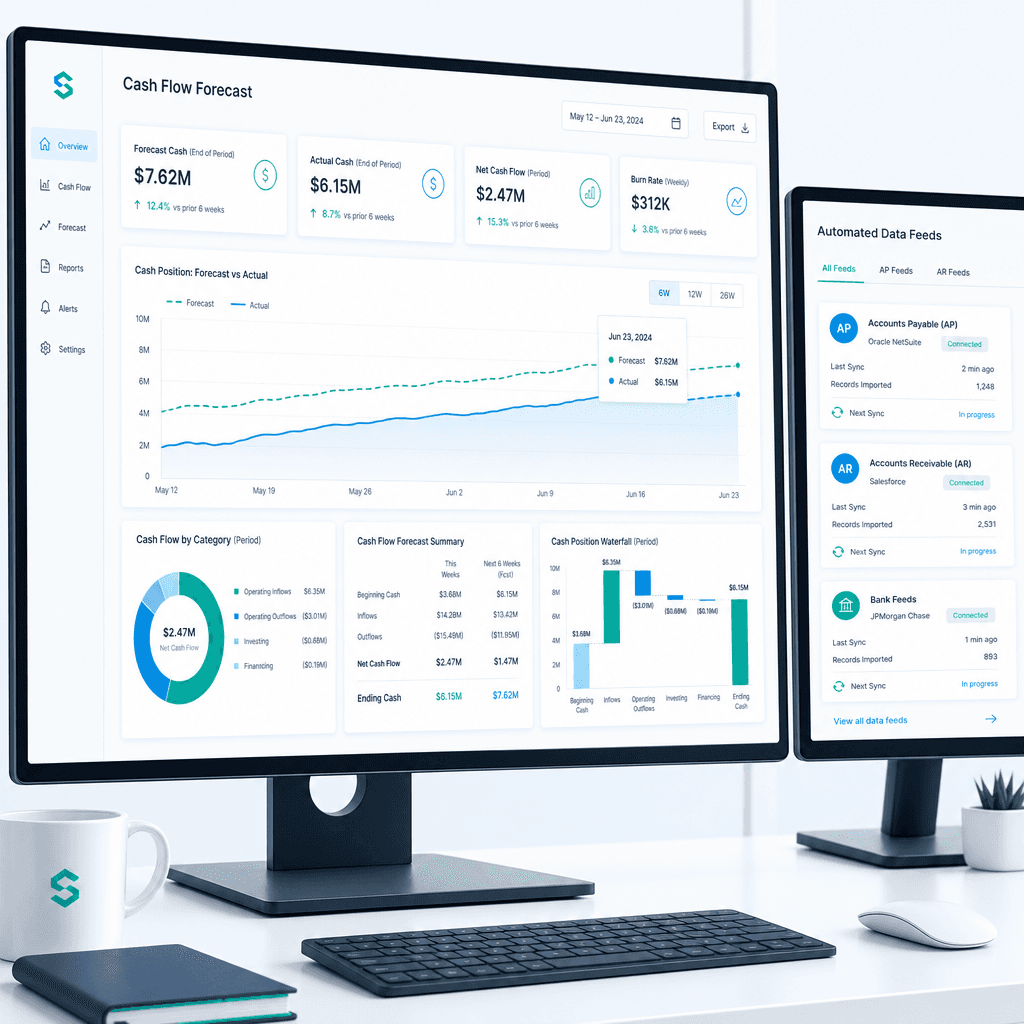
Cash Flow Forecasting Automation: A Practical Guide for Australian Finance Teams (2026)
If your finance team rebuilds the cash flow forecast from scratch every week or every month, you already know where the time goes. Someone pulls an AR ageing…
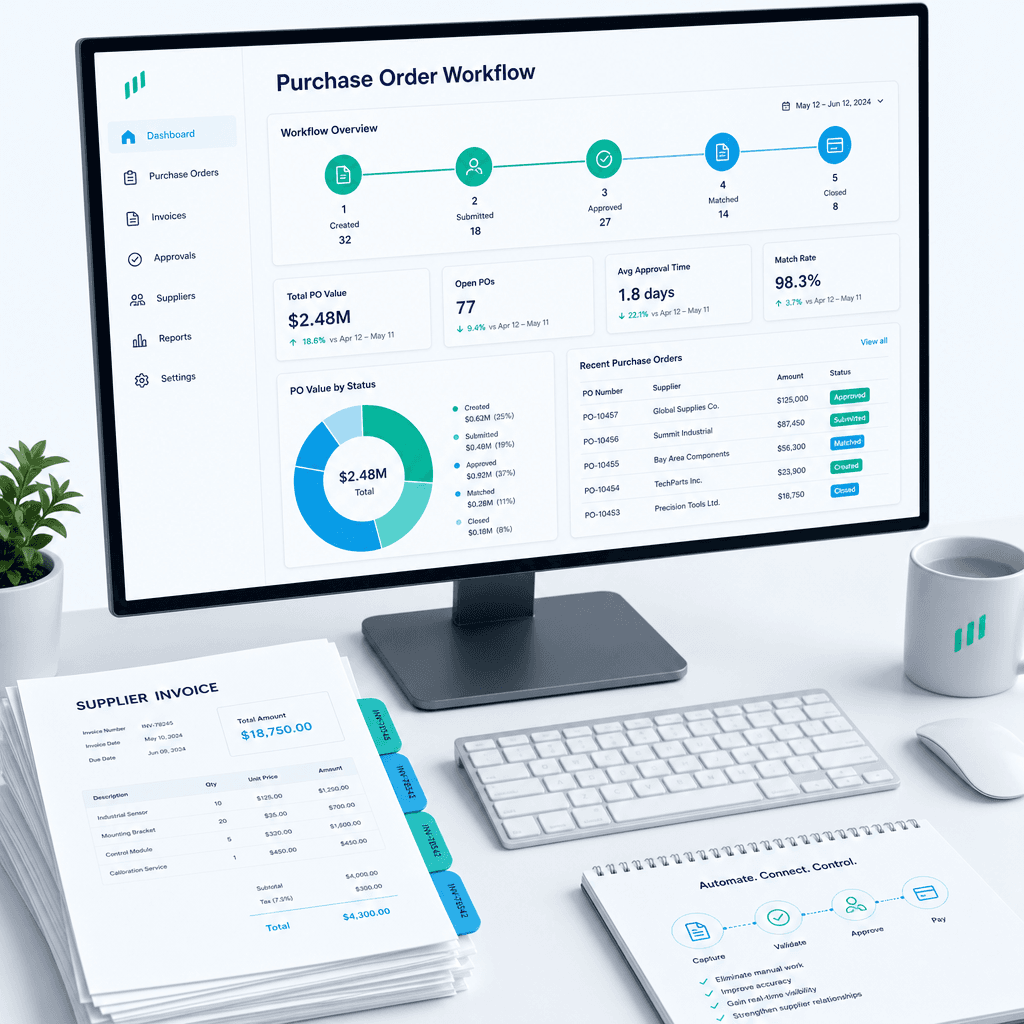
Purchase Order Automation: A Practical Guide for Australian Finance Teams (2026)
If your finance team is still raising purchase orders in a shared inbox, chasing approvals over email, and manually matching invoices line by line before month…
Finance Automation Buyer's Guide for Australian Finance Teams: How to Choose, Scope & Measure Automation That Delivers (2026)
Most finance automation buying decisions are made the wrong way. Teams evaluate vendors on feature lists, watch polished demos, and sign contracts based on…